Site Search
Search within product
第720号 2020(R02).05発行
Click here for PDF version
§山形・宮城の伝統野菜(里芋各種)産地における土壌調査
Miyagi University, School of Food Science and Industry
齊藤 秀幸
§ Fertilizers and nutrients:
被覆燐硝安加里(ロング・ハイコントロール・Nutricote)の特性について(その1)
Shibata Professional Engineers Office
柴田 勝
Soil Survey of Traditional Vegetable (Taro) Production Areas in Yamagata and Miyagi
Miyagi University, School of Food Science and Industry
齊藤 秀幸
Introduction
近年,全国各地において伝統野菜(地域在来種)の再発見・再活用が盛んである。「伝統野菜」に明確な定義はないが,①ある地域で世代を超えて栽培され,②栽培者自らの手で種とりや繁殖が行われ,③特定の料理や用途に用いられる野菜と考えられる(山形在来作物研究会,2010)。それらは地域の貴重な遺伝資源であるとともに,地域の歴史を今に伝える文化遺産でもある。また,その風味は当該地域の土壌の状態と密接であるといわれている。換言すれば,その独特の風味は他の地域で栽培するとなかなか出せないといわれている。
On the other hand, in Yamagata and Miyagi prefectures, there are various local varieties of taro. In both prefectures, taro stew parties are often held on riversides in autumn, and have become an autumn tradition. For example, in inland Yamagata Prefecture, beef is usually used in the soy sauce flavor, while pork is usually used in the miso flavor in Miyagi Prefecture. Although individual differences in taste and perception of flavor are likely to be significant, the influence of soil physical and chemical properties on flavor is not insignificant. In this paper, we conducted a soil survey of taro (a local native variety) production areas in Yamagata and Miyagi prefectures as a clue to considering the relationship between soil physical and chemical properties and flavor.
2. Major local taro species in Yamagata and Miyagi Prefectures
First, a bird's-eye view of the main local taro species in Yamagata and Miyagi prefectures is presented. All of them are well adapted to the soil and climate of their respective regions, but their exact origin is not always clear. The taro is often characterized by its "stickiness" or "stickiness. Some people also cite the taro's inherent sweetness and the rich earthy aroma that permeates the nose.
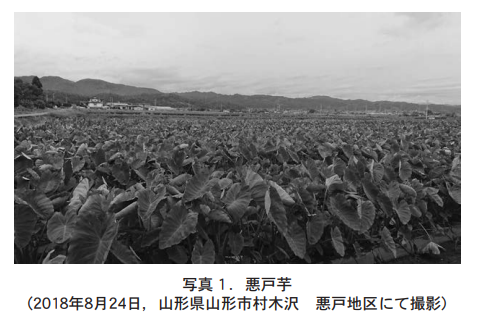
①悪戸イモ;山形市西部の村木沢地区に古くから伝わる地域在来種であり,特に須川沿いの砂壌土の集落(悪戸)で良品が生産されている。葉柄の地際が赤くなるのが特徴で,芋煮などにして食べると,粘りとふわっと溶けるような食感がある(山形在来作物研究会,2010)。一時は存続の危機にさらされたが(斎藤ら,2001),近年,復活し,山形の代表的な伝統野菜となった。「悪戸」という地名は悪土・安久土に通じ,肥沃な土地を意味している(村木沢地区振興会,1989)。須川(最上川支流)の扇状地(砂壌土)に位置し,蔵王の温泉地から水が流れてくるので,土壌は酸性でミネラルが豊富である。
Jingoemon taro: This is a local variety that has been passed down from generation to generation by the Sato family of Osawa, Mamurogawa-cho, northern Yamagata Prefecture, under the family name "Jingoemon". This taro is considered to belong to either the red-bud variety or the karaimo variety, and when cooked in taro stew, it is soft and sticky to the touch, but has a light texture on the palate. However, the yield is a little lower than that of economic varieties.
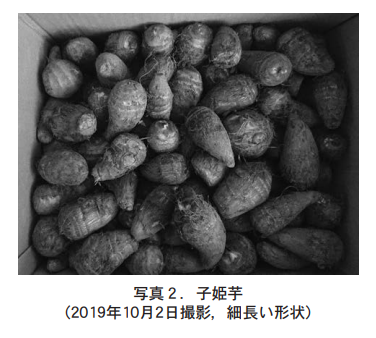
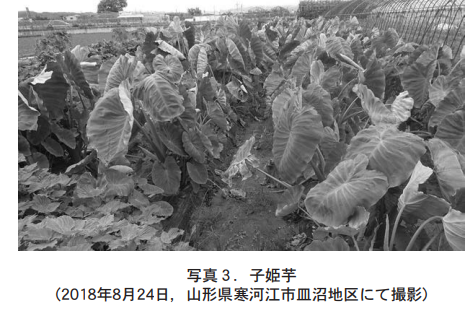
③子姫芋;山形県のほぼ中央部の寒河江市皿沼地区の地域在来種である。ねっとりしたなめらかな食感とほのかな甘みを持つのが特徴である。この皿沼地区は江戸時代には度々洪水に見舞われ,それによって肥沃な砂壌土が形成されている(山形在来作物研究会,2010)。栽培上の留意点としては「輪作」と「有機質資材による土壌改良」である。3〜4年サイクルで他の野菜を作付けし,堆肥施用を積極的に行っている。
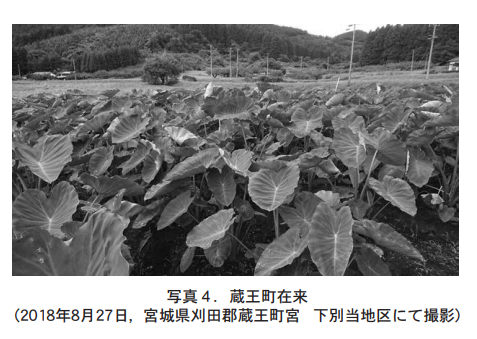
Zao Town in southern Miyagi Prefecture is a major producer of taro in the prefecture, and various strains exist, with the Shimobetsutou area being particularly famous. Because of its topography, the Shimobetsudo area is less prone to frost damage, and the soil is typical volcanic ash soil. The potatoes have a sticky texture, and it is said that this stickiness cannot be obtained if the potatoes are grown in other areas.
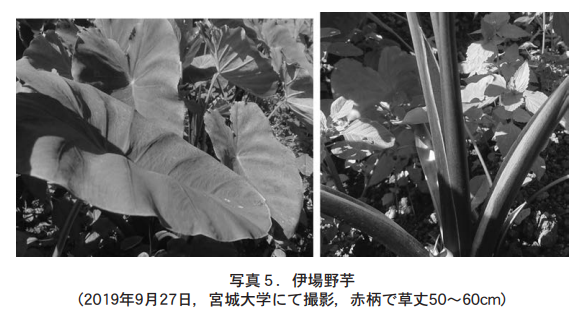
Ibano sweet potato is a local species that has been handed down in the Kami-Ibano district of Sanbongi-cho, Osaki City, Miyagi Prefecture. According to "Comprehensive Guide to Local Vegetables by Prefecture" (2002, No Bunbun Kyokai), it is called "Dodaru" type. It is soft and sticky, and is suitable for various dishes. However, its yield is slightly lower than that of economic varieties. It is characterized by its reddish pattern. It is important to note that once a field is planted, it should not be planted again for three years.
3. soil survey in various locations
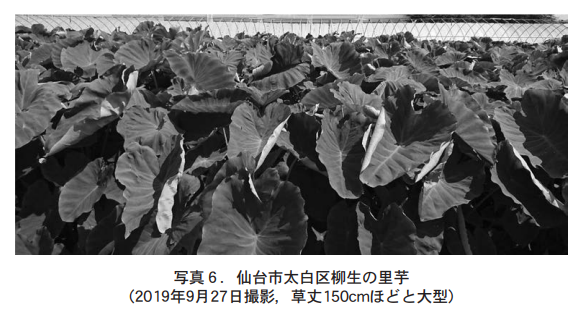
上記の品種のうち,子姫芋,蔵王町(下別当)在来および伊場野芋について,生産地の土壌を採取し(深さ5〜10cm程度),分析を行った。なお,参考として仙台市太白区柳生地区の圃場からも土壌を採取した。当該地区の圃場では里芋(品種不明)の生育がきわめて旺盛で葉柄長が1.5mを超えていたためである。サンプリングはいずれも2018年8月〜9月にかけて行った(表1)。
4. physical properties of field plots
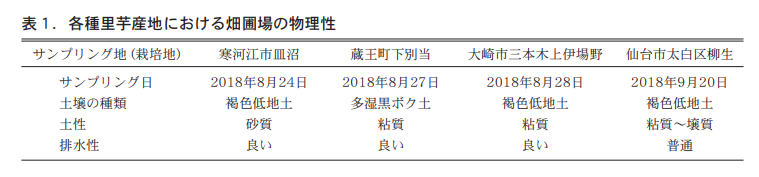
調査結果を表1に示す。寒河江市皿沼地区(子姫芋の畑圃場は褐色低地土に分類され,土性は砂質であった。地名に「沼」が付くだけに江戸時代から洪水に悩まされてきた地区でもあり,洪水の度に肥沃な砂壌土が形成されてきた(山形在来作物研究会,2010)。
The field plots in the Shimobetsudo district (native to Zao Town) were classified as humid black-bok soil, and the soil texture was clayey. The soil is clayey. Because the area is located at the foot of Mt.
大崎市三本木町上伊場野地区(伊場野芋)の畑圃場は褐色低地土に分類され,土性は粘質であった。鳴瀬川沿いに位置する低地であるため,水害に遭いやすいとのことである(生産者よりの聞き取り)。
The Yagyu area is located along the Natori River in Taihaku-ku, Sendai City, and the field plots were classified as brownish lowland soil with clayey to loamy texture.
5. the chemistry of the field plots
The results of the chemical properties analysis are shown in Table 2.
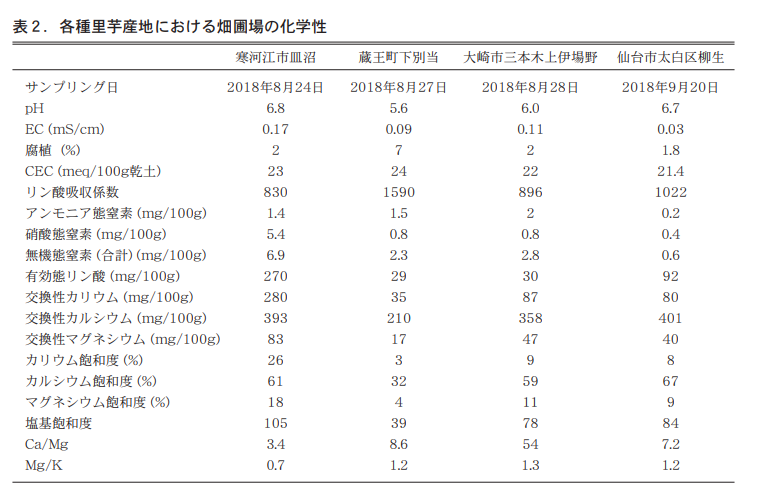
1)寒河江市皿沼地区(子姫芋);
pHが6.8とほぼ中性であった。養分関係については,有効態リン酸が270mg/100g,交換性カリウムが280mg/100gと高かった。カリウム飽和度26%,塩基飽和度105%も目立って高かった。一方,同じ山形県内でも山形市村木沢悪戸地区は酸性土である。子姫芋の食感には「ねっとりしたなめらかさ」,悪戸芋の食感には「ふわっと溶けるような」感じがあると言われている(山形在来作物研究会,2010)。この食感の違いについては,品種特性や土壌の違いについて,今後比較してみる必要があると思われる。
2)蔵王町下別当地区(蔵王町在来);
腐植の7%が目立って高く,「ふかふかの土」であった。リン酸吸収係数が1590と高めであった。リン酸吸収係数が高いとリン酸を施用しても土壌に吸着されやすく,当該土壌は典型的な黒ボク土の化学性を示していると考えられた。また,養分関係では交換性カルシウム(210mg/100g)と交換性マグネシウム(17mg/100g)の少なさが目立った。
3)大崎市三本木町上伊場野地区(伊場野芋);
決して肥沃とはいえない土壌であるが,草丈が低く,草姿が小ぶりであることを考えると,適正な養分量は賄われていると思われた。
4)仙台市太白区柳生地区;
pHが6.7とほぼ中性であった。養分関係については有効態リン酸が92mg/100gとやや多めで,交換性マグネシウムが40mg/100gとやや低めであった。アンモニア態窒素が0.2mg/100g,硝酸態窒素が0.4mg/100gと少なかったが,このことは当該地区の里芋の生育が旺盛であったことを考えると少し意外に感じた。
Summary
近年,伝統野菜が遺伝資源として,そして地域おこしの一環として注目を浴びるようになってきた(松本,2012)。それにともない,里芋の在来種は河川流域で比較的肥沃な地域に多く残っていることが明らかになってきた(松本,2012)。
In an attempt to summarize the survey, the following is a summary of the results.
1)里芋の生育に適する土壌pHは6.6〜7.0の弱酸性から中性である(久保井,1978)。仙台市太白区柳生地区および寒河江市皿沼地区の土壌pHはそれぞれ6.7および6.8と生育に適する程度であったが,蔵王町下別当地区および大崎市三本木上伊場野地区の土壌pHはそれぞれ5.6および6.0とやや低いと考えられた。
2)腐植(%)については,蔵王町下別当地区では高く,その他の地区では低かった。河野・栗波(1992)によれば,腐植質多湿黒ボク土で栽培した里芋では,フルクトース,グルコースおよびスクロースの含量が高いとされている。
3)土壌の種類については,細粒強グライ土で栽培した里芋では各糖類およびヒドロキシプロリン含量が低いと考えられている。ヒドロキシプロリンは可溶性の甘いアミノ酸であり,食味に関係すると推察される(河野・栗波,1992)。寒河江市皿沼地区,大崎市三本木上伊場野地区および仙台市太白区柳生地区の土壌は褐色低地土であり,グライ土ではないので,土壌の種類が食味に影響している可能性は高いと思われる。
4)土壌の化学性については,寒河江市皿沼地区でミネラルの豊富さが感じられた。
As described above, although all of the taro varieties investigated in this study were renowned for their production area and reputation for excellent taste, no clear relationship was found between the soil properties of each taro production area and the taro varieties. This suggests that the effects of soil physical and chemical properties on the growth of taro and its flavor and taste may not necessarily be in sync with each other. Some producing regions have their own secrets in soil preparation, and some of the respondents said that it is a "trade secret" so to speak.
河野・栗波(1992)によれば,里芋の糖類含量には品種の影響が最も大きく,次いで土壌の種類の影響が大きい。また,里芋における食味の区分は「ぬめりタイプ」と「ほくほくタイプ」に大別され,個人の嗜好性が分かれるところである(松本,2012)。このように,里芋の風味や食味は様々な要因が複雑に絡み合って評価されるものと考えられる。
It is highly likely that the physical and chemical properties of the soil affect the flavor and taste of taro, but since the sampling in this study was limited to a very small area in each production area, it was not possible to make a good relationship between the two. Further studies will clarify this aspect by increasing the number of samples, analyzing the components of the harvest, and carefully conducting sensory tests.
Acknowledgements
Ms. Miona Takanai (from Yamagata Prefecture), a student of the Department of Food Resources Development in the Food Science and Technology Group of our university, gave us her opinions on the selection of the survey site and on the tastes and flavors of the taro. We would like to express our gratitude to her.
Bibliography
1)山形在来作物研究会.2010.おしゃべりな畑−やまがたの在来作物は生きた文化財− 〜どこかの畑の片すみでⅡ〜.84−85.88−89.山形大学出版会.
(2) Murakizawa Area Promotion Association. 1989. murakizawa Encyclopedia. 185. Yamagata City Murakizawa Community Center.
3)斎藤秀幸・千坂知行・小黒仁司・高橋信典. 2001.宮城県内における在来種・有用遺伝子源の調査.宮城県農業短大学報.49:59−66.
4) Takii Seed Co. 2002. 2002.
5) Matsumoto, M. 2012. taro - From cultivation to storage and seed potato production. 36.42.
6) KUBOI, Ei. 1978. Effect of growing conditions on the growth of satoimo (Arachis hypogaea). Tropical Agriculture. 21(3);183-188.
7) Michiyoshi Kohno and Satoshi Kurinami, 1992. content of soluble sugars and hydroxyproline in taro tubers and their
その変動要因.日本土壌肥料学雑誌.63 (3);196−203
Fertilizers and nutrients:
被覆燐硝安加里(ロング・ハイコントロール・Nutricote)の
特性について(その1)
Shibata Professional Engineers Office
柴田 勝
(1) What is coated phosphorus nitrate ankari (long, high control, Nutricote)?
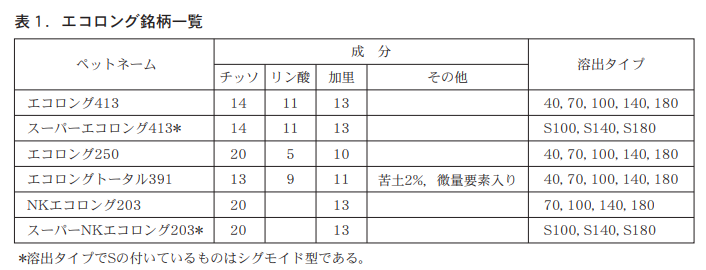
被覆燐硝安加里はポリオレフィン系樹脂で50%程度の硝酸態チッソを含む硝酸系化成肥料(燐硝安加里,NK化成)を被覆した肥料の総称である。代表的な銘柄を表1に示す。エコロングの被膜は光崩壊性と微生物分解性を持っている。
Many other brands containing trace elements and with elution periods exceeding 270 days are commercially available.
(2) Properties of thiessotropic fertilizers
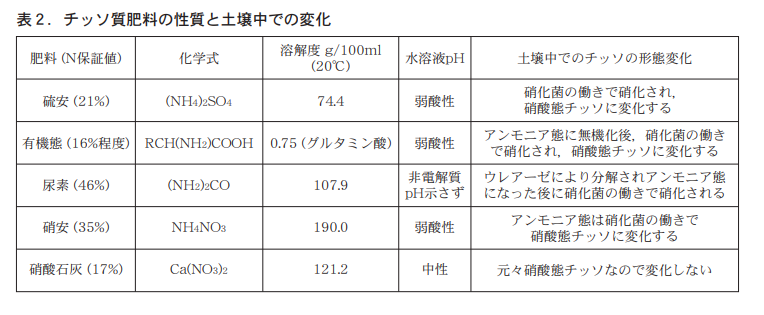
土壌粒子は陽イオン交換容量(陽イオンを吸着する能力:CEC)を持っているので,陽イオン養分の土壌中での移動に影響する。一方,土壌の陰イオン交換能は小さい。施肥された,あるいは有機態チッソが無機化されて生じたアンモニア態チッソ(NH4⁺)は土壌粒子に吸着されるので,土壌中の移動は殆ど見られないが,陰イオンである硝酸イオンは土壌に吸着されることなく土壌水中を移動(拡散)する。
尿素は硫安や硝安のような電解質ではないので,土壌のCECの影響を受けないが,土壌中に存在する尿素分解酵素ウレアーゼによってアンモニアと二酸化炭素に速やかに分解されるので,結果的にアンモニア態チッソと同様の挙動を示す(表2)。
(3) Changes in the Form of Chisso in Soil
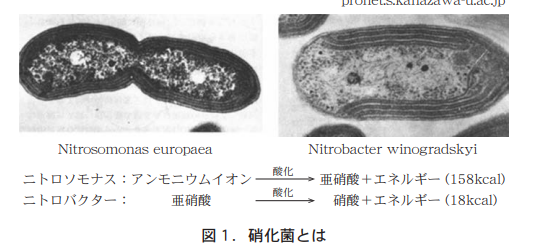
畑地など,陸上において,アンモニア態チッソの硝酸態チッソへの変化(いわゆる硝化)は硝化菌と呼ばれる,①アンモニア態チッソを酸化して亜硝酸にする亜硝酸菌(ニトロソモナス)と②亜硝酸を硝酸に酸化する硝酸菌(ニトロバクター)の働きによって行われる。これらの微生物はアンモニア態チッソと亜硝酸態チッソを体内に取り込み,獲得したエネルギーを使って生育している,畑土壌へ硝酸態チッソを供給する重要な微生物である(図1)。
Since most field crops are nitrate-loving plants, nitrification has a significant impact on crop production. When nitrification does not occur smoothly, crops do not grow well, and fertilized ammonium-form nitrogen accumulates in the soil as ammonium ions, making it easy for excess ammonia damage to occur.
The degradation (mineralization) of urea occurs by the degrading enzyme urease, which is secreted by the microorganism outside the fungus, as in equation (1).
①(NH2)2CO+H2O→2NH3+CO2
次に②式に示すように生成したアンモニア態チッソは硝化菌の働きで硝化を受けて亜硝酸態チッソを経て,硝酸態チッソとなる。
②2NH3+3O2→2HNO2+2H2O
2HNO2+1/2 O2→2HNO3
土壌中での①尿素の無機化速度と②硝化速度は同調せず,尿素分解速度>硝化速度となっていることが多い。硝化速度に影響(遅延)する外的要因には土壌温度(低温)や土壌消毒があり,これらは硝化菌の活性を低下させる(図2)。よって,尿素を施肥した場合は土壌中での硝化動向に注意する必要がある。
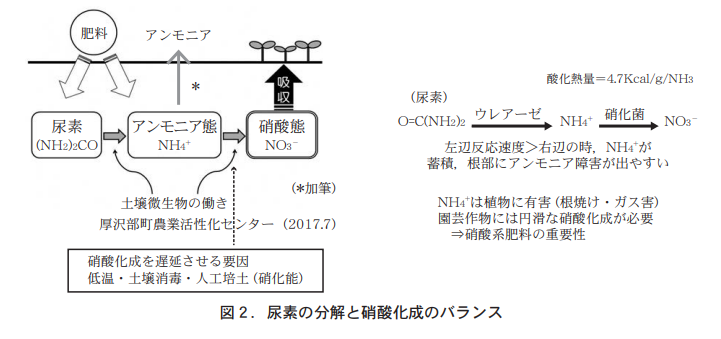
The compound resulting from the decomposition of urea is thought to exist in the soil in the form of ammonium carbonate. Ammonium carbonate, which is inherently slightly alkaline, is easily autolysed into ammonia and carbon dioxide. If urea-derived ammonia is not nitrified quickly, it can easily cause ammonia-induced root burn symptoms and ammonia gas injury.
This phenomenon does not occur with ammonium sulfate. Ammonium sulfate is a weakly acidic compound in which ammonium ions are combined with sulfate ions, so it does not form free ammonia. Urease is a unique enzyme that degrades urea in the pH range 6.5 to 7.5 and is active even in alkaline conditions. In this pH range, the activity of nitrifying bacteria decreases while that of urease does not, which is one of the reasons why the rates of urea degradation and nitrate formation are not synchronized.
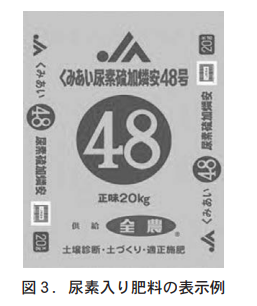
尿素を原料にした化成肥料の登録名称には,例えば「尿素硫加燐安48号」のように「尿素」が付記されており,尿素を使用しない「硫加燐安〇〇〇」と区別されている(図3)。これは苦土石灰などのアルカリ性資材を酸度矯正のために施肥することが多い畑地においては,尿素入り化成肥料を使用した場合は,アンモニアの害が出ないように定植までの日数を余分にとるなど使い方に注意した方が良いことを使用者に知らせるための表示でもある。
In humans, there have been cases of hyperammonemia due to urea decomposition in urine by bacteria that have infected the urinary tract and produced ammonia, resulting in consciousness disorders. Free ammonia is toxic to all living organisms.
(4) Nutricote, going into space!
(Photo 1)
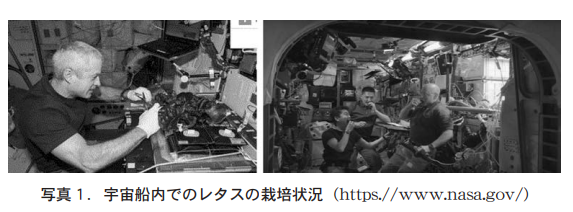
Photos of lettuce being grown on board a spacecraft and eaten by the crew can be found on the Internet.
Growing vegetables in space is probably intended to ensure self-sufficiency of fresh vegetables for a long stay in space, but the healing effect cannot be overlooked. It is thought that this is one of the methods to regulate the increase of carbon dioxide concentration in the spacecraft by fixing a part of carbon dioxide gas, which is estimated to be generated from the breath of an adult male at about 0.7 kg/day/person, with plants, and the generated carbon dioxide gas is absorbed and separated, and released outside the spacecraft.
培土に施肥する肥料には,硝酸態チッソを含むジェイカムアグリ(株)のNutricote18−6−8+ME(微量要素)270タイプが採用されている。船内温度は21℃〜25℃に維持され,また培地の微生物活性は高くないので,アンモニア態チッソの硝化は遅い。順調に生育したレタスを収穫するには,レタスが好む硝酸態チッソの供給に加えて,その他肥料成分や微量要素を含み,その供給がコントロールされた複合コーティング肥料が必要であり,Made in USAの類似コーティング肥料との比較試験から,溶出コントロール性能に優れたNutricoteが採用された。NASAではその他の作物でも栽培試験が行われているようである。
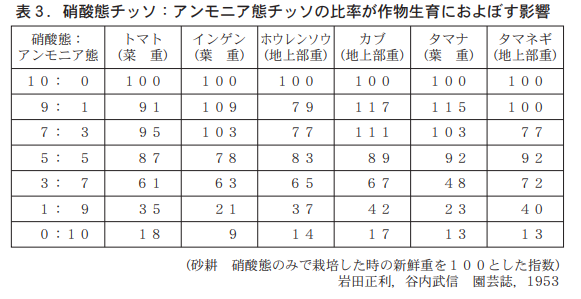
地球上であろうが,宇宙空間であろうが,硝酸態チッソなくしては野菜は育たないという事実が背景にある(表3)。その内にNutricote,火星に行く!となるかもしれない。
(5) Signaling effects of nitrate ions
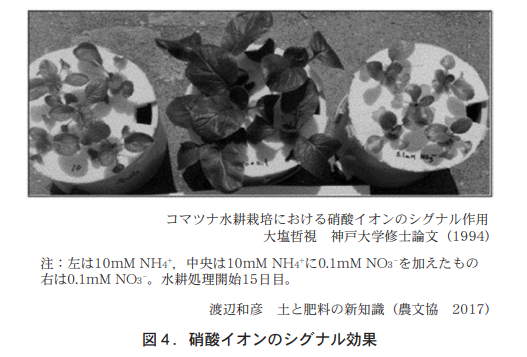
コマツナ(好硝酸性作物)はアンモニア態チッソをほとんど利用できないが,1%程度の硝酸態チッソを添加すると劇的な生育を示す(硝酸イオンのシグナル作用)。硝酸イオンはチッソ養分としての役割以外にアンモニア態チッソを養分として利用する,植物体内のチッソ代謝を活性化する役割も担っている(図4)。